Maximum Useful Autonomy
Finding the Right Balance in the Pre-AGI Era
TL;DR – The goal is maximum useful autonomy: the highest level of AI autonomy that is still worth it. In complex, judgment-heavy work, increasing autonomy makes sense only while the additional productivity gain exceeds the verification cost it introduces.
As we move from AI proofs of concept into real workflow automation, the question changes.
How much of the process can we automate?
How much autonomy is actually useful?
AI is getting very fast at producing work. Human comprehension is not accelerating at the same rate. That matters in workflows where there is no single correct answer and no clean pass/fail test.
Automating individual actions is relatively straightforward: retrieve data, extract information, populate a table, summarize evidence, draft an output. Connecting these actions into a more autonomous workflow changes the problem.
At first, more autonomy gives clear gains. AI does more of the execution and humans spend less time on repetitive work. But once too much research and reasoning happens outside human oversight, we start outsourcing our thinking. We still cannot outsource our understanding.
Verification becomes the bottleneck: the human expert now has to reverse-engineer the result, retracing the steps AI took to produce it.
- Where did this finding come from?
- Why was this source selected and another excluded?
- Which assumptions were made?
- Was conflicting information identified?
- Did an early error propagate into later steps?
At that point, review becomes reconstruction. The time saved through automation starts coming back as verification debt.
This applies to judgment-heavy domains where the quality of the result is not directly testable and cannot be established by fact-checking alone, so domain expertise remains an integral part of the verification process.
In any domain that requires critical thinking, we do more than check whether the facts are correct. We assess whether the evidence is relevant, the comparisons are meaningful, the assumptions hold, and conflicting information changes the conclusion. These judgments depend on the context and purpose of the decision.
That is the design boundary I find most interesting: how much human involvement can be reduced without distancing the expert from the reasoning process to the point where verification starts to consume the savings.
Maximum useful autonomy is the highest level of autonomy before the next autonomous step costs more to verify than it saves.
Or more simply: The highest autonomy that is still worth it.
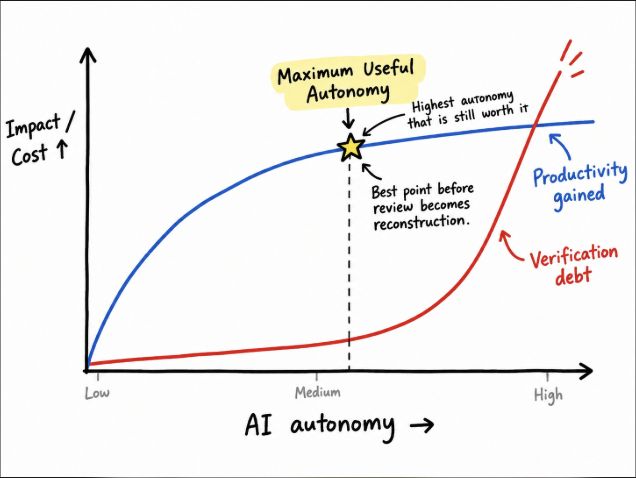
Below that point, useful automation is being left on the table. Beyond it, the system can produce work faster than humans can confidently understand and validate it.
As organizations move beyond proofs of concept and design AI-enabled workflows for complex, judgment-heavy work, the interesting design task is to place human judgment at the steps where it materially changes the outcome. The rest should be automated as aggressively as reliability allows.
The quality of the system may ultimately depend on whether it can recognize the point at which another autonomous step costs more than human judgment.